
The brands that win BFCM 2026 have already started building their creative. If you’re still waiting to launch new ads in November, you’ll be paying 40–60% higher CPMs while running untested creative—a reliable way to waste a significant portion of your Q4 budget.
This guide lays out the creative strategy framework I use with US DTC clients: when to start, what to test, how to read signals fast, and how to lock your winning creative library before the Black Friday window opens. The framework applies whether you’re spending $20K or $500K over BFCM.
Why Creative Is the Primary Lever During BFCM
Most DTC founders over-invest in audience architecture and under-invest in creative quality during BFCM. On Meta’s Advantage+ and broad targeting, the algorithm’s ability to find your buyer is largely commoditized—it’s become a commodity layer. What isn’t commoditized is your message, your offer clarity, and your ability to stop the scroll at the moment your competitor’s ad appears right next to yours.
This matters more in 2026 than it did two years ago. Meta’s current system reads ad creative content semantically to determine audience fit—what practitioners call “creative as targeting.” The algorithm finds your buyer based on what your creative communicates, not just who you target manually. This shifts leverage further toward creative quality and breadth.
During BFCM, your ICP sees 3–5× more ads than a typical week. Ad fatigue accelerates dramatically. Creative that performs well in October may exhaust itself within 48 hours in late November. The brands that win are the ones with a deep, tested creative bench—not the ones with a single hero video made in September.
Three creative realities for BFCM 2026:
- You need 8–15 tested creatives ready before Black Friday week, not 2–3
- Winning creatives during BFCM are almost always offer-led, not brand-led
- The first 1–2 seconds of video and the first line of copy matter more than total ad length
The BFCM Creative Sprint Timeline
Given today is late October, here’s the compressed timeline that still works. Brands that started their creative production in September are ahead—41% of brands are actively testing creative variations before BFCM, according to Attentive’s 2026 survey. If you’re starting now, you can still build a competitive bench with a focused sprint.
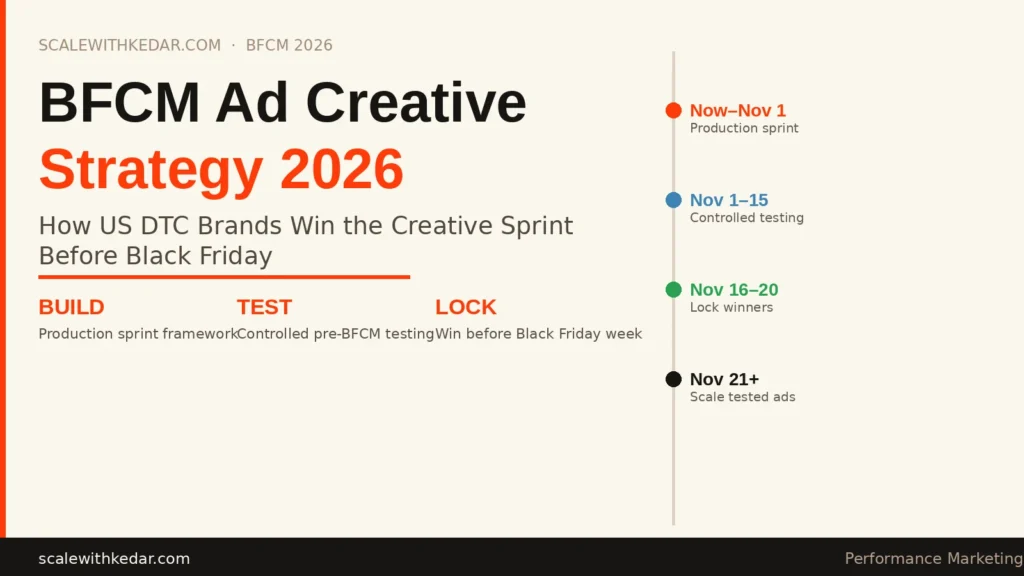
Now through November 1: Production Sprint
This is the window to produce your full creative library. Prioritize volume over perfection—you’re making hypotheses, not masterpieces. Aim for:
- 3–5 static image variations (different hooks, offer angles, formats)
- 3–5 short video creatives (15–30 seconds; hook-led, offer in first 5 seconds)
- 2–3 UGC-style videos if your product category lends itself to social proof
- 2–3 direct response copy angles per creative (urgency, social proof, savings framing, transformation)
November 1–15: Controlled Testing Window
Run small-budget tests ($25–50/day per ad) to identify which hooks, offers, and formats generate the best cost-per-click and early purchase signals. You’re not optimizing for ROAS yet—you’re identifying which creative angles deserve your BFCM budget.
Key metric at this stage: thumb-stop rate (video holds), link CTR (static), and add-to-cart rate where trackable. Don’t let spend run long enough to push for purchase-optimized results—you need directional signals, not conclusive data.
Recommended structure: Use Advantage+ Shopping Campaigns for this test phase with broad creative variety. Run each variation at equal budget. Let the algorithm distribute impressions and surface early winners without manual audience constraints limiting the signal.
November 16–20: Lock and Load
By November 16, your creative decisions should be final. Identify your top 4–6 tested creatives, produce final polished versions if needed, and prepare your campaign structure. Any creative not in your top performers by November 16 should be excluded from BFCM scaling—do not give untested creative your peak budget.
Black Friday Week: Scale Tested Winners Only
During the peak window (November 21–December 2), your only job on the creative side is monitoring fatigue signals and swapping in fresh variants of proven top performers. Do not test new concepts during peak—the CPM cost of a failed test at peak rates is disproportionately high.
Related: BFCM Paid Media Audit Checklist — pre-flight checklist before you increase BFCM spend.
Creative Frameworks That Work for US DTC Brands
1. The Direct Offer Hook (Best for Sub-$100 Products)
Lead with the offer in the first 3 words. “40% off. Today only.” “Free gift with every order.” Customers in BFCM mode are shopping with intent—they don’t need to be convinced the category matters. They need to know your deal is worth stopping for.
This works best for commodity-adjacent products where price and value are the primary decision factors. If you’re selling $30 candles, $60 skincare basics, or $80 kitchen accessories, lead with the number.
2. The Problem-First Hook (Best for $100–$500 Products)
For higher-consideration purchases, lead with a specific problem statement that creates immediate recognition: “If you’re still using [X], you’re spending $Y too much per month.” or “Most [target customer] make this mistake when choosing [category].”
This format works because it filters for your actual buyer in the first sentence. You’re not trying to convert everyone—you’re resonating immediately with the people who already feel the problem.
3. The Social Proof Anchor (Best for Categories with High Review Volume)
Lead with a specific customer result or review: “10,847 US customers switched to [product] this year. Here’s what changed for them.” This format creates credibility in the feed before a skeptical buyer engages with your offer.
The specificity matters. “Thousands of happy customers” does nothing. “10,847 customers” earns a second look because it’s specific enough to feel real.
4. The Comparison Creative (Best for Challenger Brands)
If you’re competing against a category incumbent, BFCM is when comparison creative earns disproportionate return. “You’ve been paying $X for [category leader]. Our version is $Y and does [specific advantage].” During BFCM, buyers are already in comparison mode—your creative just has to enter that conversation.
5. The Top-Performer Overlay (Highest Reliability)
This is the most consistently reliable BFCM creative approach: take your best-performing ad from the last 90 days and add an offer overlay. “Now 40% off through November 29.” You’re not reinventing—you’re adding the BFCM reason to act to something that already converts. Practitioners report this outperforms building new BFCM-specific creative most of the time.
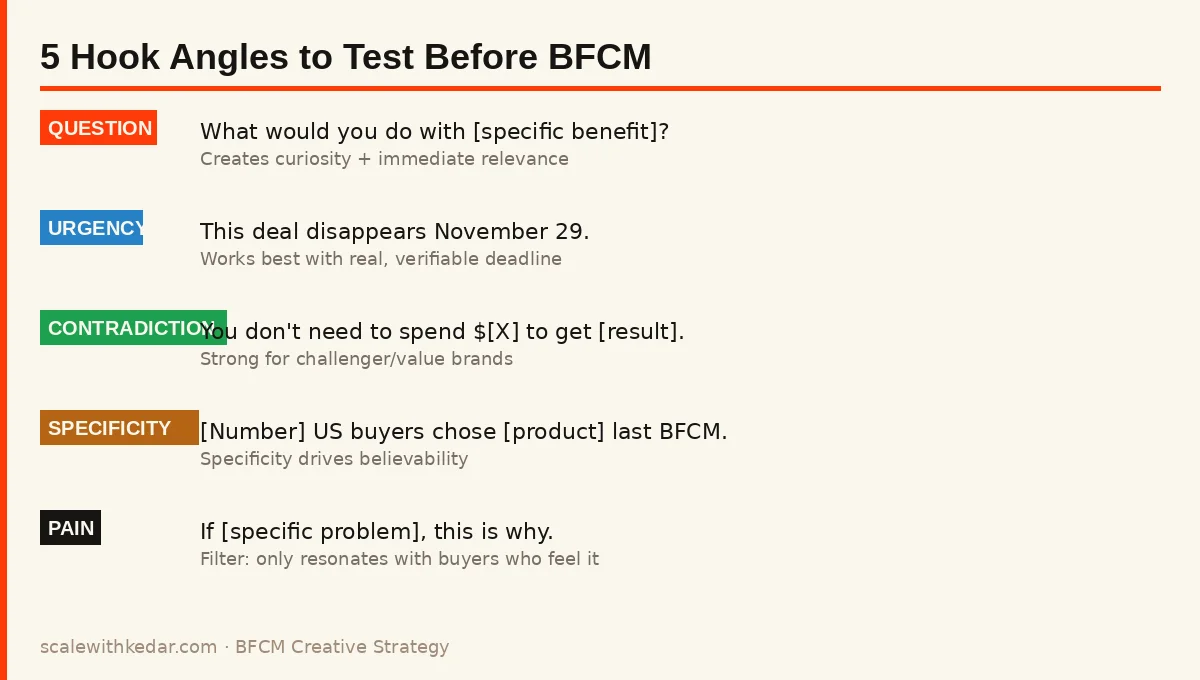
What to Test Right Now
With 5 weeks to BFCM, the highest-leverage test you can run this week is a hook variation test. Take your single best-performing creative from the last 30 days and produce 4–6 new hook variants. Keep everything else identical—same offer, same body, same CTA. Change only the first 1–3 seconds (video) or the headline (static).
This test isolates the variable that matters most during a high-competition period and gives you actionable data within 3–5 days at modest spend ($30/day per variant).
Creative Fatigue Signals to Watch
Knowing when to pull a creative is as important as knowing what to run. Fatigue signals during BFCM move faster than normal—an ad that ran well for three days can collapse in performance within 12–24 hours at peak spend.
Creative lifespan has compressed meaningfully under Meta’s current system compared to prior years. Plan your refresh schedule before Black Friday, not during it.
Watch these metrics daily during BFCM week:
- CVR drops while impressions hold steady: Most reliable leading indicator — shows up before CTR falls
- CTR drop of 30%+ from creative’s peak: Signal to swap, not to reduce budget
- Frequency above 3.5–4.0: On prospecting audiences, refresh with a variant
- Hook rate and hold rate falling together: The algorithm is showing it; no one’s watching — act when two or three signals align simultaneously
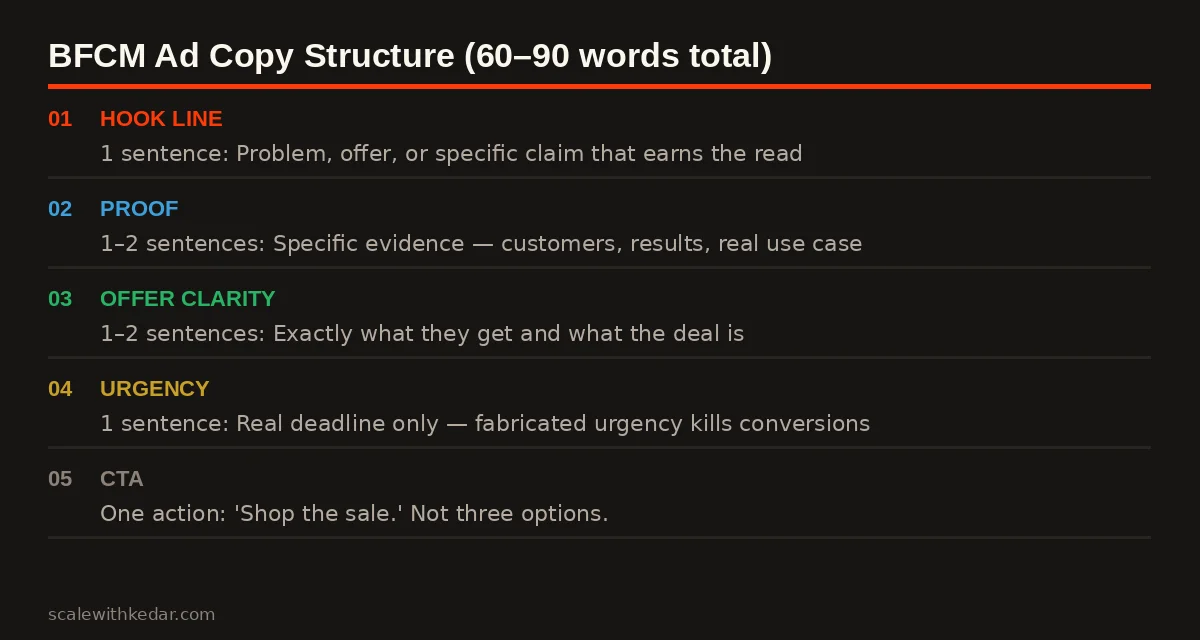
The Ad Copy Structure That Converts During BFCM
For Meta feed ads during high-competition periods, this structure consistently outperforms long-form copy for DTC:
- Hook line (1 sentence): Problem, offer, or specific claim that earns the read
- Proof sentence (1–2 sentences): Specific evidence—number of customers, a specific result, a real use case
- Offer clarity (1–2 sentences): What they get, exactly, and what the deal is
- Scarcity/urgency (1 sentence): Real deadline or availability constraint only—fabricated urgency destroys trust and conversions
- CTA: One action. “Shop the sale.” Not three options.
Total copy target: 60–90 words for the primary text. Buyers in BFCM mode skim. Your best copy communicates the complete case in 15 seconds of reading.
See also: Klaviyo BFCM Email + SMS Strategy — synchronize your ad messaging with email and SMS flows for consistent conversion.
UGC vs. Polished Creative: The Honest Answer
Creator-style content often outperforms polished brand video on Meta for DTC—vendor benchmarks consistently report 15–30% CTR improvements, though most are self-reported by UGC platforms and haven’t been independently verified. The more reliable signal is practitioner consensus: formulaic UGC (identical selfie angles, same testimonial structure) now reads as low-authenticity because everyone runs it.
Format matters less than message clarity and offer strength. That said, there are real category patterns:
UGC-style creative performs better for:
- Beauty, wellness, and personal care (social proof is the primary purchase driver)
- Products with a strong transformation story (before/after)
- Brands with under 50K social followers (borrowed credibility)
Polished direct-response creative performs better for:
- Home goods, kitchen, and utility categories (product quality is the primary signal)
- Established brands with strong visual equity
- Gift categories where the product has to look gift-worthy in the ad
Most DTC brands should test both formats during their pre-BFCM testing window and let data decide—not opinion.
Related: BFCM Attribution Mistakes That Cost DTC Brands — the measurement errors that make winning creatives look like losers.
Common Creative Mistakes That Waste BFCM Budget
- Running untested creative during peak: Any creative you haven’t tested before November 20 should not receive meaningful BFCM budget. The risk-adjusted cost of a failed test at peak CPMs is too high.
- Offer vagueness: “Up to 40% off select styles” is weaker than “40% off everything sitewide, now through Sunday.” Specificity drives click decisions.
- Not pre-building your refresh library: Plan your creative refresh schedule before Black Friday. Pre-produce 2–3 variant versions of your top 3 performers so you can swap without stopping to produce during peak.
- Ignoring message match: The best BFCM creative sends to a dedicated offer page, not your homepage. If your ad promises 40% off and the landing page shows full-price collections, you’ve paid for a click you won’t convert.
- Copying last year’s creative: BFCM audiences remember. Brands that recycle prior-year creative often see lower engagement because returning shoppers recognize it and stop paying attention.
Also read: DTC Checkout Optimization for BFCM 2026 — ensure your landing pages convert the traffic your ads drive.
Your Action Plan for This Week
If you’re reading this in late October and haven’t started your creative testing sprint yet, you’re not too late—but you need to prioritize this week. The testing window closes faster than founders expect.
- Identify your single best-performing ad from the last 30 days
- Brief 4–6 hook variations (you can write these in 30 minutes)
- Get production completed by October 28
- Launch your hook test at $30/day per variant on November 1
- Read results by November 8 and lock your BFCM creative library
Get a BFCM Creative Audit Before You Spend
If you’re a US DTC or ecommerce brand preparing for BFCM and want an outside set of eyes on your current creative strategy, ad account structure, and offer architecture before you scale budget, reach out here. I work with a small number of brands on focused pre-BFCM strategy engagements.